Contact us
Send Us Your Details
Please fill out the form below and a member of our team will be in contact with you.


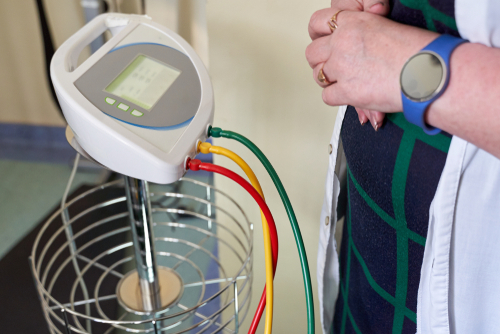
If your doctor recently ordered an ankle-brachial index test, or ABI, you may be looking at a number on your results and wondering what it actually means for your health. This simple, noninvasive test gives your care team meaningful information about blood flow in your legs and can also help inform your broader cardiovascular risk assessment.
At The Cardiac and Vascular Interventional Group, we believe in guiding our patients through every step of their heart and vascular care with clarity and compassion. One heart, one family, one mission. If you have questions about your ABI results, call (469) 437-3560 to talk with our team.
An ankle-brachial index test compares the blood pressure in your ankle to the blood pressure in your arm. It’s a simple, noninvasive way for your care team to check how well blood is flowing to your legs and feet, and it can help identify peripheral artery disease, or PAD, a condition in which narrowed or blocked arteries can reduce blood flow to the legs and feet, often because of atherosclerosis, or plaque buildup within artery walls.
Your provider measures systolic blood pressure at the ankles and arms. For each leg, the ABI is calculated by dividing the higher ankle pressure by the higher arm pressure. In a healthy circulatory system, blood pressure in the ankle should be similar to, or slightly higher than, blood pressure in the arm, so the resulting ratio falls within an expected range.
Current clinical guidelines, including those from the American College of Cardiology and American Heart Association, classify resting ABI results into the following ranges:
| ABI Score | Classification |
| 1.00 to 1.40 | Normal |
| 0.91 to 0.99 | Borderline |
| 0.90 or lower | Abnormal |
| Above 1.40 | Noncompressible |
An ABI between 1.00 and 1.40 generally suggests that blood is flowing adequately to your legs and feet. A normal result is reassuring, though it doesn’t rule out every possible cardiovascular concern on its own, particularly if you have other risk factors or symptoms your provider is monitoring.
A borderline result, between 0.91 and 0.99, does not confirm PAD on its own. If you have symptoms or risk factors, your provider may recommend additional evaluation or monitoring over time. Your provider may recommend monitoring this result over time, along with a closer look at cardiovascular risk factors like blood pressure, cholesterol, and smoking history.
A score of 0.90 or below is classified as abnormal and supports a diagnosis of peripheral artery disease when interpreted alongside your symptoms, medical history, and physical examination. This doesn’t necessarily mean you’re experiencing symptoms right now, but it does mean your provider will likely want to evaluate your vascular health more closely and discuss next steps for treatment and monitoring.
A result above 1.40 is also considered abnormal, but not because circulation is somehow “too good.” A high reading can occur when leg arteries are difficult to compress, often because of arterial stiffness or calcification, making them resistant to compression during the test.
This can limit how accurately the ABI reflects blood flow in the legs. Your provider may recommend further testing, such as a toe-brachial index, to better assess circulation.
An ABI test evaluates blood flow to the legs and can also identify PAD, a condition linked with a higher risk of cardiovascular events. An abnormal result may point to peripheral artery disease even when leg symptoms are absent, helping your care team identify risks and guide the next steps for protecting your heart, brain, and circulation.
Many people associate peripheral arterial disease with leg pain during walking, but PAD can be present without this classic symptom. Because of this, an ABI test can uncover vascular narrowing that a patient might not otherwise notice or report to their doctor. This matters because PAD isn’t limited to affecting your legs. Because PAD is associated with atherosclerosis elsewhere in the body, an abnormal ABI can be an important marker of increased cardiovascular risk, including risk for heart attack and stroke.
An abnormal ABI result is an important finding, but it is only one part of your complete cardiovascular picture. Your provider will consider your symptoms, medical history, circulation, and individual risk factors to determine whether further evaluation or a personalized treatment plan is appropriate.
Depending on your symptoms and results, next steps may include additional noninvasive circulation testing, imaging when it would help guide treatment decisions, and a personalized plan to manage cardiovascular risk factors.
Depending on your specific ABI result and overall health picture, your provider may recommend additional testing, such as additional circulation testing, exercise ABI testing if leg symptoms occur with walking despite a normal or borderline resting result, toe-brachial index testing when the ABI is noncompressible, or imaging when your provider needs more detail to guide care.
For many patients, care begins with addressing cardiovascular risk factors, including blood pressure, cholesterol, diabetes or blood-sugar management when applicable, tobacco cessation, physical activity, and other lifestyle or medication recommendations tailored to the individual.
Many ABI results can be reviewed during a scheduled follow-up visit. However, new or worsening symptoms may need prompt medical attention, including:
Call 911 for chest pain or discomfort, sudden severe shortness of breath, fainting, or a sudden cold, pale, numb, weak, or severely painful leg or foot. For new wounds that are not healing, new pain at rest, or other non-emergency circulation concerns, contact The Cardiac and Vascular Interventional Group promptly at (469) 437-3560.
Understanding your ABI results is an important part of taking charge of your cardiovascular health, but numbers on a page are only the beginning of the conversation.
At The Cardiac and Vascular Interventional Group, we believe every patient deserves to understand what their results mean and what comes next, guided by a team that treats you like family.
Our heart and vascular care team is here to walk you through your results, answer your questions, and help you take the next right step for your health. If your results suggest PAD or another circulation concern, our team can help you understand the findings and discuss appropriate next steps for your care.
Contact The Cardiac and Vascular Interventional Group at (469) 437-3560 today to talk about your ABI results and what they mean for you.